
Here is a detailed analysis of why this sample response achieves a Band 5 for Task Achievement, Cohesion & Coherence, Lexical Resource, and Band 4 for Grammatical Range & Accuracy based on the information previously shared:
Here’s a detailed analysis of this sample response, scored based on Task Achievement, Cohesion & Coherence, Lexical Resource, and Grammatical Range & Accuracy:
Task Achievement: Band 5
Strengths:
- Attempt to summarize the data: The response makes an effort to describe the trends of the stock prices for the four companies.
- Identifies some key features: The candidate correctly notes that Facebook’s stock increased, Yahoo’s stock declined, and Google’s stock remained stable.
Weaknesses:
- Inaccurate and incomplete summary: The overview is not entirely clear or accurate. For example, Apple’s changes are described vaguely, and there is no mention of the magnitude of its fluctuations or proper comparisons with other companies. There is also confusion in how the candidate describes some details (e.g., “Apple value was change every year” is overly simplistic and lacks specificity).
- Insufficient data support: The candidate does not provide accurate or consistent data to support all trends. For example, the phrase “its range was near around 5,000” is vague and does not include the exact value from the graph.
- Lack of clarity in key comparisons: The response fails to effectively compare the trends across the companies. Comparisons like those between Facebook and Yahoo are not well-developed, and Apple’s volatility is not properly explained.
Overall, the response lacks the clarity and detail needed for higher bands in Task Achievement.
Cohesion & Coherence: Band 5
Strengths:
- Basic organization of information: There is an attempt to group the information logically, with separate paragraphs discussing Apple, Facebook, Yahoo, and Google.
Weaknesses:
- Inconsistent cohesion: The use of linking devices is limited and often inappropriate. For example, the use of “But” to connect sentences is repetitive and not always logically correct. More varied and accurate cohesive devices are needed to link ideas more naturally (e.g., “While,” “In contrast,” “Similarly”).
- Poor paragraphing: The ideas in each paragraph are jumbled, with awkward transitions between points. For example, the Facebook stock description is mixed in with Apple’s, creating confusion. There is also no clear progression from one company to the next, and the information on Google is tacked on at the end with minimal explanation.
- Lack of clarity: Many sentences are unclear and awkwardly phrased, which affects overall coherence. Sentences like “it stuck at a starting point” are difficult to understand and fail to contribute to a cohesive analysis of the data.
The lack of clear organization and appropriate cohesive devices weakens the score for Cohesion & Coherence.
Lexical Resource: Band 5
Strengths:
- Basic vocabulary related to the task: The candidate uses some basic vocabulary related to stock trends, such as “increased,” “dropped,” “range,” and “value.”
Weaknesses:
- Limited range of vocabulary: The candidate uses a very limited range of vocabulary, often repeating the same basic words like “range,” “value,” and “change” throughout the response. This repetition reduces the overall effectiveness of the language used.
- Inappropriate and imprecise word choice: Some word choices are either inappropriate or unclear, such as “range” instead of “price” or “stock value” and “touch near about” instead of “fell to” or “reached.” The phrase “it stuck at a starting point” is also unclear and imprecise in describing Google’s stable stock price.
- Informal expressions: Words like “stuck” are too informal for an academic writing task, which requires more formal and precise language.
The limited range of vocabulary and use of inappropriate or unclear expressions result in a lower score for Lexical Resource.
Grammatical Range & Accuracy: Band 4
Strengths:
- Some variety in sentence types: There are attempts to use different sentence structures, such as simple, compound, and complex sentences.
Weaknesses:
- Frequent grammatical errors: The response contains frequent grammatical mistakes, particularly in verb tense and subject-verb agreement. For example, “The Apple value was change” should be “The Apple value changed,” and “But the Facebook value are grow up” should be “But Facebook’s value grew.”
- Inconsistent use of articles and prepositions: Errors in article use (“The Apple value” should be “Apple’s value”) and prepositions (“it was reach peak point” should be “it reached a peak”) are common throughout the response.
- Awkward and unclear sentence structures: Many sentences are awkwardly constructed and difficult to understand. Phrases like “its range was near around 5,000” and “it stuck at a starting point” are unclear and grammatically flawed.
- Lack of control over complex sentences: When attempting more complex sentences, the candidate struggles to use appropriate connectors and maintain grammatical accuracy. For example, “its value was changed every year and it range was near around 5,000” is awkward and contains multiple grammatical issues.
Due to frequent errors in verb forms, sentence structure, and basic grammar, this response scores lower for Grammatical Range & Accuracy.
Final Scores:
Task Achievement: 5
Cohesion & Coherence: 5
Lexical Resource: 5
Grammatical Range & Accuracy: 4
This sample response demonstrates a basic understanding of the task but lacks the clarity, cohesion, and grammatical accuracy needed for a higher score. Improvements in task focus, organization, vocabulary range, and grammatical control would be necessary to achieve a higher band score.
Here’s an improved version of the band 5 sample, taking into account the feedback provided:
Revised Report:
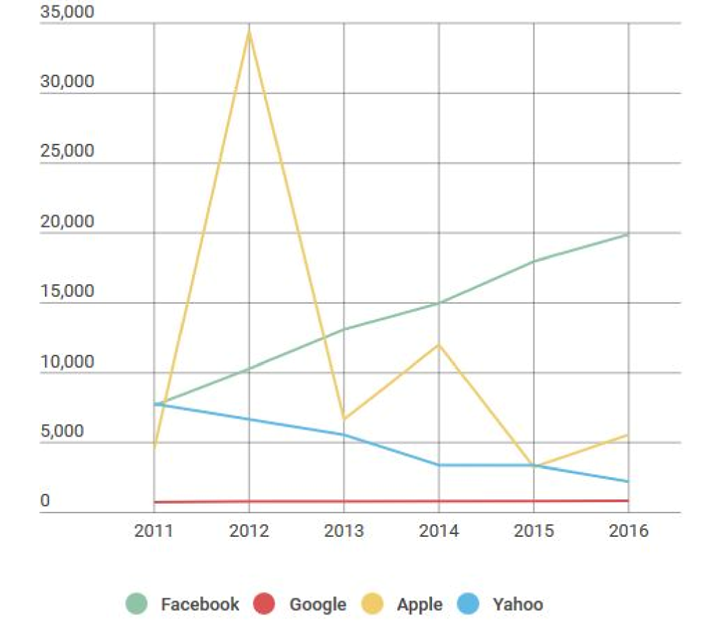
The line graph illustrates the stock prices of four major technology companies—Apple, Facebook, Yahoo, and Google—over the period from 2011 to 2016.
Overall, Facebook’s stock price steadily increased throughout the period, while Yahoo’s stock experienced a continuous decline. Apple’s stock fluctuated significantly, and Google’s stock remained largely stable over the five years.
In 2011, Apple’s stock was valued at just under 5,000. It surged dramatically to nearly 35,000 in 2012, making it the highest among the four companies, before dropping sharply to about 7,000 in 2013. Although it recovered to around 12,000 in 2014, Apple’s stock fell again, closing at just over 5,000 by 2016. In contrast, Facebook’s stock price started at around 7,500 in 2011 and consistently rose each year, reaching a peak of 20,000 by 2016.
Yahoo began the period with a similar stock price to Facebook, just under 7,500 in 2011. However, its value steadily decreased each year, falling to around 2,500 by 2016. Meanwhile, Google’s stock remained the most stable, starting and ending the period at approximately 1,000, with no notable fluctuations throughout the five years.