
Talking About Frequency
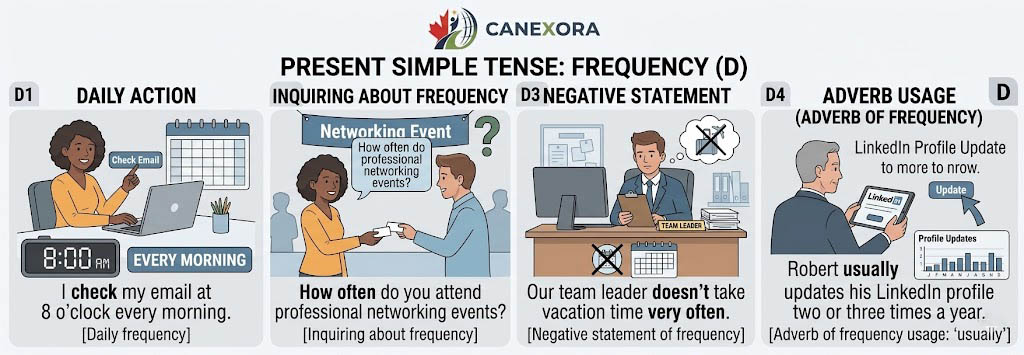
We use the Present Simple to show how often an action happens. To make this clear, we usually use two types of words: time phrases (like every morning) or adverbs of frequency (like usually, always, sometimes, never).
1. Regular Time Phrases (When?)
These phrases usually go at the very end of your sentence to show a fixed schedule.
-
I check my email at 8 o’clock every morning. (This shows a steady, daily frequency.)
2. Inquiring About Habits (How Often?)
When you want to know someone else’s routine, start your question with “How often,” followed by do or does.
-
How often do you attend professional networking events? (This asks about their regular professional habits.)
3. Negative Frequency (Not Often)
To say that an action rarely happens, use don’t or doesn’t alongside words like very often.
-
Our team leader doesn’t take vacation time very often. (This is a negative statement about how often someone takes a break.)
4. Adverbs of Frequency (How Regularly?)
Words like usually, always, and often tell us the general habit. These words sit before the main action verb.
-
Robert usually updates his LinkedIn profile two or three times a year. (This uses an adverb to describe a yearly habit.)
💡 The Frequency Scale
To help you choose the right adverb, think of them on a scale from 100% to 0%:
-
Always (100% of the time)
-
Usually (Most of the time)
-
Often (Frequently)
-
Sometimes (Occasionally)
-
Hardly ever / Rarely (Almost never)
-
Never (0% of the time)