
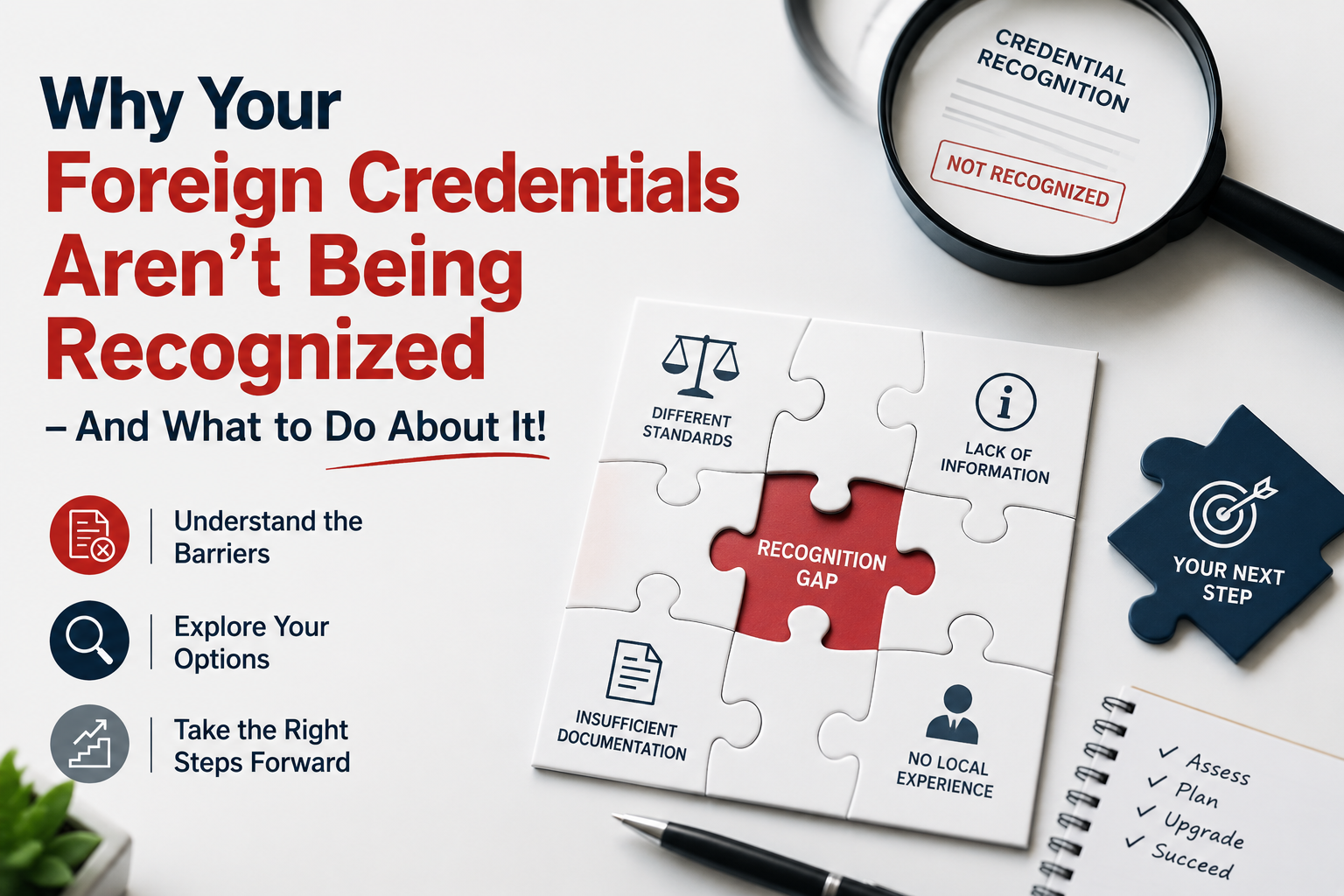
You worked hard for your degree. You spent years earning your professional designation. You may have even held a senior position in your home country. And yet, here in Canada, you’re being asked to “prove” yourself all over again – or worse, you’re being quietly passed over for jobs you’re clearly qualified for.
If this sounds familiar, you’re not alone. Credential recognition is one of the most frustrating challenges newcomers face in Canada. But understanding why it happens – and knowing the steps you can take – can make a real difference.
Why Canada Doesn’t Automatically Accept Foreign Credentials
Canada does not have a single national system for recognizing foreign education or professional experience. Instead, recognition depends on:
- Who is doing the hiring (an employer, a regulatory body, or a licensing authority)
- What province or territory you’re in
- What field or profession you’re in
This means the same degree from the same university abroad could be treated differently in Ontario versus British Columbia. It can feel arbitrary – and sometimes it is – but there are structural reasons behind it.
1. Regulated vs. Non-Regulated Professions
Canada divides work into two broad categories:
Regulated professions are fields where you must be licensed by a provincial regulatory body before you can legally work. These include:
- Medicine and nursing
- Engineering
- Law
- Teaching
- Pharmacy
- Trades (electrician, plumber, etc.)
In these fields, your foreign credentials must go through a formal assessment and approval process. The regulatory body – not your employer – decides whether your training meets Canadian standards.
Non-regulated professions – like marketing, finance, IT, or journalism – don’t require a licence. Here, it’s up to the individual employer to decide whether your foreign education and experience are acceptable. This is where bias and unfamiliarity often play a bigger role than actual standards.
2. Employers Don’t Always Know How to Evaluate Foreign Credentials
Many Canadian hiring managers simply aren’t familiar with international universities or professional systems. When faced with a degree they don’t recognize, some default to caution – not because your education is inferior, but because they don’t know how to compare it.
This is a perception problem as much as a skills problem.
3. Credential Assessment Takes Time (and Newcomers Often Skip It)
Many newcomers arrive in Canada without having their credentials formally assessed beforehand. Without a recognized equivalency report, employers and regulatory bodies have nothing official to go on.
Step-by-Step: What You Can Do About It
Step 1: Find Out If Your Profession Is Regulated
The first thing you need to know is whether your field is regulated in the province where you plan to work.
- Visit canada.ca/en/immigration-refugees-citizenship/services/new-immigrants/new-life-canada/work-regulated-unregulated.html for an overview.
- Search for your specific profession on your provincial government website (e.g., Ontario, BC, Alberta).
- Contact the regulatory body directly to ask what their process is for internationally trained applicants.
Step 2: Get a Credential Evaluation (Even If It’s Not Mandatory)
Even in non-regulated fields, having your credentials formally assessed adds credibility to your application. The main organizations that do this in Canada are:
- World Education Services (WES) – the most widely recognized; accepted by most employers, schools, and immigration authorities: wes.org
- Comparative Education Service (CES) – University of Toronto
- International Credential Evaluation Service (ICES) – British Columbia
- International Qualifications Assessment Service (IQAS) – Alberta
A credential evaluation will give you an official document showing the Canadian equivalent of your degree. It typically costs between $200–$300 CAD and takes several weeks, so plan ahead.
Tip: WES evaluations are also accepted as part of Express Entry immigration applications, so they serve double duty.
Step 3: Contact the Regulatory Body in Your Province (If Applicable)
If you’re in a regulated profession, reach out to the relevant regulatory body as early as possible. Each body has its own process, timelines, and fees, but they generally require:
- A credential assessment (like a WES report)
- Proof of work experience
- Language proficiency test results (IELTS, CELPIP, or TEF)
- Possibly additional exams or bridging courses
Examples of regulatory bodies:
- Nurses → CARNA (Alberta), CNO (Ontario), BCCNM (BC)
- Engineers → Engineers Canada member organizations (PEO in Ontario, APEGA in Alberta, etc.)
- Doctors → Medical Council of Canada (MCC) + provincial colleges
- Teachers → Provincial ministries of education
Don’t wait until you’ve arrived in Canada to start this process. Many internationally trained professionals begin the licensing process before they immigrate, which can shave months or even years off the timeline.
Step 4: Look Into Bridging Programs
Bridging programs are designed specifically for internationally trained professionals who need to fill gaps between their foreign credentials and Canadian requirements. They’re often subsidized or free.
These programs can include:
- Additional coursework
- Workplace placements or mentorships
- Exam preparation
- Language for the workplace training
Search “bridging program [your profession] [your province]” to find options. Some well-known examples:
- CARE Centre for Internationally Educated Nurses (Ontario)
- Engineering Connections (BC)
- Internationally Educated Teachers Program (various provinces)
- Internationally Educated Lawyers Program (Ryerson/Toronto Metropolitan University)
Step 5: Consider Upgrading or Supplementing Your Credentials
If full licensure will take years, consider whether a shorter Canadian certification could help you get working sooner. For example:
- An internationally educated accountant might pursue the CPA designation while working in a related finance role
- A foreign-trained engineer might work as an engineering technologist while pursuing a P.Eng licence
- A lawyer might work in legal research or compliance while studying for Canadian bar exams
This approach keeps you employed, builds your Canadian experience, and helps you enter your profession through a side door while working toward the front door.
Step 6: Use Settlement Services
You don’t have to figure all of this out alone. Free settlement services across Canada can help you:
- Understand the credential recognition process in your field
- Connect you with the right regulatory bodies
- Refer you to bridging programs and employment supports
- Review your resume and help you prepare for interviews
Key resources:
- ACCES Employment (Ontario): accesemployment.ca
- S.U.C.C.E.S.S. (BC): successbc.ca
- ISIA (Immigrant Services Calgary): isacalgary.com
- Immigrant Services Association of Nova Scotia (ISANS)
- Find services near you: settlement.org or findahome.ca
A Note on Patience – and Persistence
Credential recognition in Canada is genuinely hard. The system is fragmented, the timelines can be long, and the emotional toll of feeling undervalued is real. Many newcomers end up in survival jobs for months or years while navigating this process, and that’s a systemic failure – not a personal one.
But the professionals who eventually break through tend to share a few things in common: they started the process early, they asked for help, and they kept showing up.
Your credentials are real. Your experience is real. Canada’s system may not make it easy – but it is navigable.
Quick Reference Checklist
- [ ] Find out if your profession is regulated in your province
- [ ] Get a credential evaluation from WES or a recognized equivalent
- [ ] Contact the relevant regulatory body and ask for their internationally trained applicants process
- [ ] Apply to any relevant bridging programs in your area
- [ ] Connect with a local settlement agency for free support
- [ ] Build Canadian experience through volunteering, placements, or related roles if needed
Have you gone through the credential recognition process in Canada? Share your experience in the comments – your story could help another newcomer navigate the same path.