
You should spend about 20 minutes on this task.
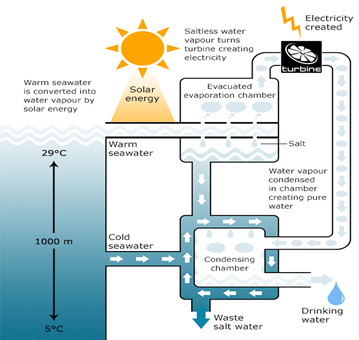
The diagram below shows the production of electricity using a system called Ocean Thermal Energy Conversion (OTEC).
Summarize the information by selecting and reporting the main features, and make comparisons where relevant.
Write at least 150 words.
(The image is attached to the lesson.)
Step 1: Analyze the Question (1 minute)
Task: Describe the process of electricity generation and pure water production using the Ocean Thermal Energy Conversion (OTEC) system.
Key Features:
- Identify the main stages of the OTEC process.
- Highlight the use of seawater and the temperature difference.
- Mention the dual outcome of electricity and pure drinking water.
Step 2: Identify Main Features (1 minute)
Overall Process:
- The OTEC system operates in three main stages: utilizing solar energy, evaporation, and condensation.
- It relies on a temperature gradient created by seawater, with water sourced from depths of up to 1000 meters.
Important Steps:
- Evaporation Stage:
- Surface seawater is heated to 29°C, enters the evaporation chamber, where salt is removed, and water evaporates to drive the turbine.
- Condensation Stage:
- Water vapor moves to the condensing chamber, where it is cooled by deep seawater, condensing back into liquid form.
- Final Output:
- The process results in electricity generation and the production of pure drinking water, with any remaining salt returned to the sea.
Step 3: Write an Introduction (30 seconds)
Summarize the diagram: “The diagram illustrates the Ocean Thermal Energy Conversion (OTEC) process for generating electricity and producing pure drinking water using seawater.”
Step 4: Write an Overview (1 minute)
Highlight main processes:
- The OTEC system utilizes solar energy and a temperature differential between surface and deep seawater to facilitate evaporation and condensation.
- This process generates electricity and yields pure drinking water as a by-product.
Step 5: Plan Detailed Paragraphs (1.5 minutes)
Body Paragraph 1: Evaporation Process
- Describe how surface seawater, heated by the sun, enters the evaporation chamber at 29°C, where it is evaporated after salt removal.
- Explain the role of the evaporated water in driving the turbine to generate electricity.
Body Paragraph 2: Condensation Process and Output
- Explain how the vapor moves to the condensing chamber and is cooled by deep seawater, leading to condensation.
- Mention that this process produces pure drinking water, while any remaining salt is returned to the ocean.
Sample Band 9 Response
The diagram illustrates the Ocean Thermal Energy Conversion (OTEC) process for generating electricity and producing pure drinking water using seawater.
Overall, the OTEC system utilizes solar energy to heat surface seawater and relies on the contrast between warm and cold water to facilitate evaporation and condensation. This process results in electricity generation and fresh water production.
In the first stage, warm surface seawater, heated to 29°C by the sun, enters the evaporation chamber. Inside, the seawater is vaporized after salt is removed, and this vapor is used to power a turbine, generating electricity. This phase highlights the crucial role of solar energy and the evaporation process in driving the turbine.
Following this, the vapor moves to a condensing chamber, where cold deep seawater, drawn from a depth of 1000 meters at a temperature of 5°C, cools the vapor back into liquid form. This condensation process produces pure drinking water, and any remaining salt is returned to the ocean.
158 words